GET ADDITIONAL 20% DISCOUNT ON FIRST PURCHASE USE CODE "FIRST20"

Why Little Hands Need Big Practice
Qluebox
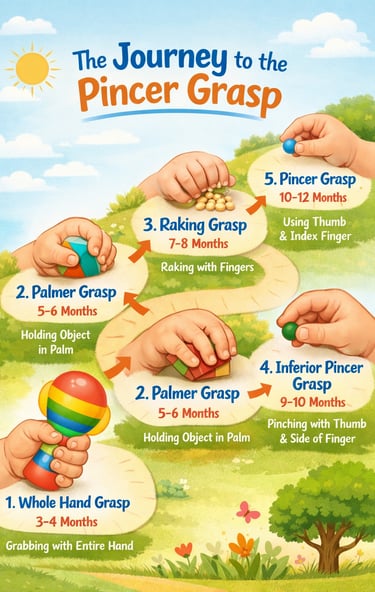
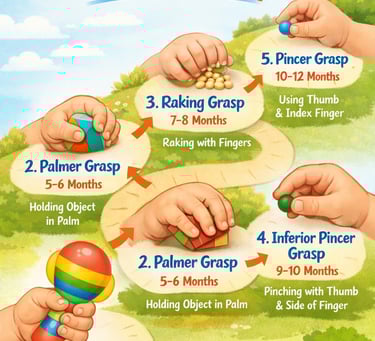
The Journey to the "Pincer Grasp"
As parents, we often celebrate the major physical milestones—rolling over, crawling, taking those wobbly first steps. These gross motor skills are obvious and exciting. But while those large muscle groups are getting all the attention, there’s a quieter, equally crucial development happening right at your child's fingertips: fine motor skills.
Fine motor skills involve the small muscles in the hands and wrists working in sync with the eyes. It doesn’t look like much—just a toddler fumbling with a puzzle piece or stacking a block—but these tiny movements are the foundation for enormous future tasks.
Here is why the simple acts of grasping, stacking, and fitting are so much more than just child's play.
Watch a baby try to pick up a toy. They usually use a "palmar grasp," raking the object with their whole hand. It’s clumsy, but effective. As they grow into toddlerhood, the goal is to refine this movement into the "pincer grasp"—using just the thumb and index finger to pick up small objects precisely.
Why does this matter? Because that tiny pincer grasp is the precursor to holding a crayon, and eventually, a pencil. It’s also essential for self-care tasks like buttoning a shirt, zipping a jacket, or opening a lunchbox.
How to practice: Toys that require picking up small, specific pieces are essential here. Puzzles with small knobs, like the English Alphabet Puzzle, force a child to use those specific fingers to lift the pieces out. Similarly, manipulating small letter tiles to build words requires precise finger control.
Stacking: The Art of Control and Balance
There are few things more satisfying to a toddler than building a tower and knocking it down. But the act of stacking is a complex neurological workout.
To stack successfully, a child needs hand-eye coordination to line up the blocks. They need depth perception to know where to place the next piece. Most importantly, they need controlled release—the ability to let go of the block at the exact right moment without knocking over the whole structure.
How to practice: Simple, uniform blocks, like the colorful wooden cubes found in pattern sets, are perfect for this. They have enough weight to provide sensory feedback and flat sides that make early stacking achievable, encouraging a child to try again and again.


Fitting: Puzzle Solving and Spatial Awareness
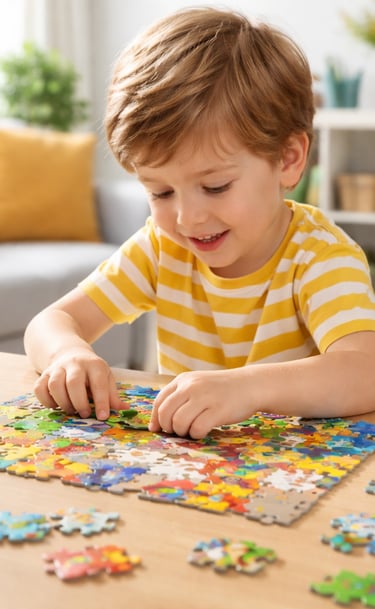
Have you ever watched your child try to jam a square peg into a round hole with sheer determination? That struggle is actually their brain learning spatial awareness.
Fitting an object into a specific space requires problem-solving. The brain has to analyze the shape of the object, compare it to the empty space, and then signal the hands to rotate the object until it fits. This is early geometry in action!
How to practice: Alphabet puzzle boards are fantastic for this. A child must recognize that the letter 'A' only fits in the 'A' slot, and they must turn it the right way up. More advanced fitting skills are developed with toys like the Cube Pattern Box, where children must arrange multiple cubes to fit a specific 2D design on a card, translating a picture into a physical reality.
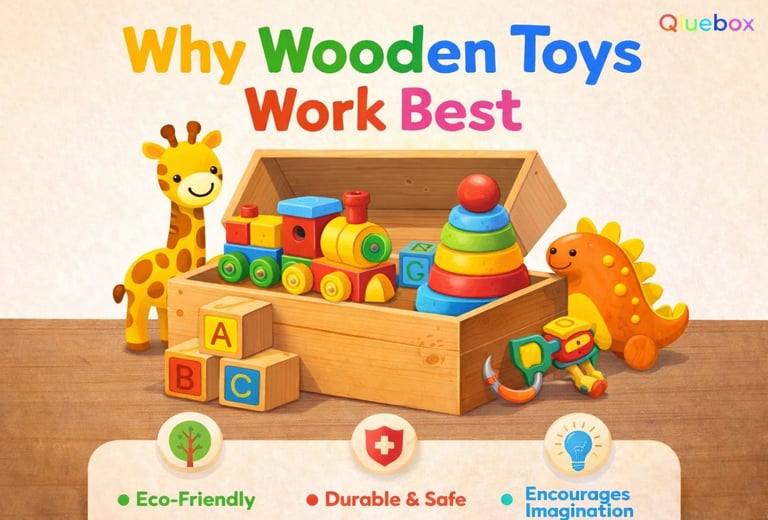
Why Wooden Toys Work Best
When it comes to fine motor development, low-tech is often high-impact. Wooden toys, like those from Qluebox, offer a tactile experience that plastic often lacks. They have weight, natural texture, and they don't flash or make noise.
This simplicity means the child has to do the work, not the toy. The quiet nature of wooden puzzles and blocks allows for deep concentration, giving those little muscles and brains the space they need to make these vital connections.
So, the next time you see your little one intensely focused on fitting a puzzle piece or delicately balancing a block, know that they aren't just playing. They are preparing their hands for a lifetime of creating, writing, and doing.
Follow us on
Qluebox
Smart Play for Growing Minds
Contact Us
Legal
© 2025 Qluebox®. All rights reserved.
Stay Up to Date