GET ADDITIONAL 20% DISCOUNT ON FIRST PURCHASE USE CODE "FIRST20"

Why I Stopped Entertaining My Toddler (And Why You Should Too)
There is a modern parenting trap that we all fall into. It usually happens around 10:00 AM on a Saturday.
You have built the fort. You have done the funny voices for the stuffed animals. You have set up the racetrack. You are exhausted, and you look at your toddler, expecting them to be satisfied. Instead, they look up at you with wide, expectant eyes and ask: "What are we doing next?"
somewhere along the way, we convinced ourselves that our job description included "Cruise Ship Entertainment Director." We believe that if our children are bored, we are failing.
I am here to tell you the opposite is true. Constant entertainment is killing their creativity.
Here is why I fired myself as my toddler’s entertainer, and why Qluebox wooden toys were the only replacement I hired.
The Danger of Being "Helpful"
When we constantly direct our children's play—"Put the blue block there," "Let's pretend to be pirates," "Look at this!"—we are inadvertently robbing them of a critical skill: Self-Direction.
If a child relies on an adult (or a screen) to provide the input, their brain stays in "receive" mode. They never have to do the heavy lifting of imagining a scenario or solving a boredom problem.
I realized that by being so "fun," I was actually training my child to be dependent.
Enter "Benign Neglect"
"Benign Neglect" is a parenting philosophy that sounds harsh but is actually rooted in deep trust. It means stepping back. It means being available for safety and hugs, but unavailable for entertainment.
It sounds like this:
Child: "I'm bored."
Parent: "I hear you. I am drinking my coffee right now. You have your toys; I’m sure you’ll think of something."
It is uncomfortable at first. There will be whining. But if you hold the line, something magical happens. The whining stops, and the playing begins.
The "Passive Toy" Requirement
This strategy only works if you have the right tools. You cannot practice Benign Neglect with an iPad (that’s just zoning out). You need toys that invite action.
This is where Qluebox fits in.
We design our toys to be Passive.
Active Toys (Battery operated/Screens): The toy sings, dances, and flashes. The child sits and watches. This is entertainment, not play.
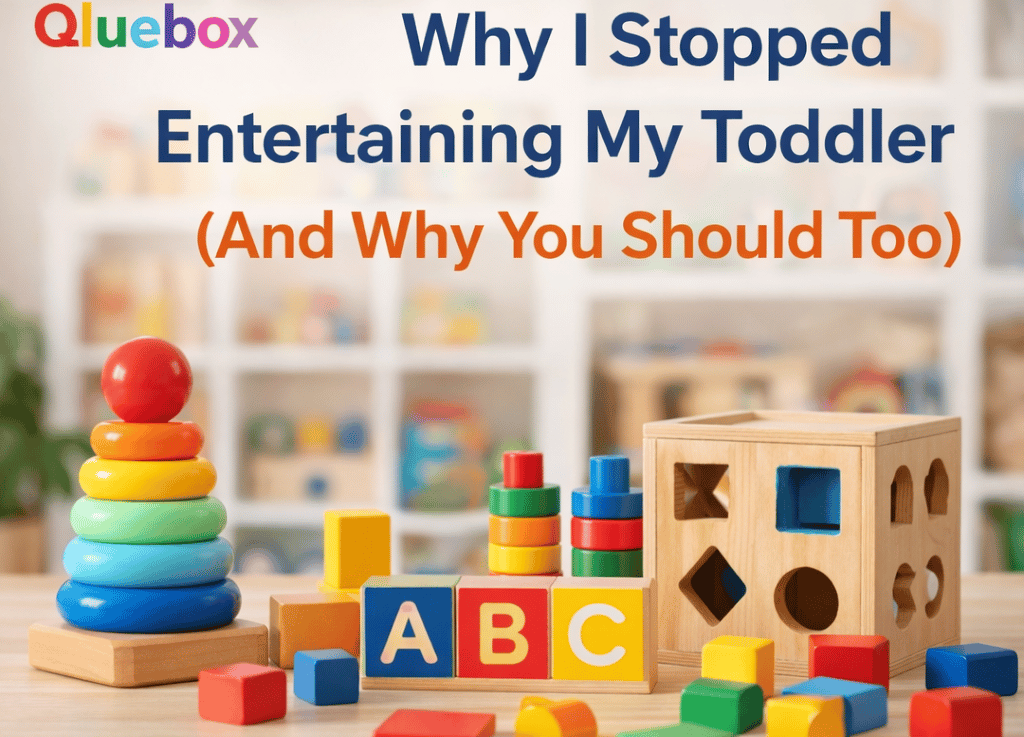
Passive Toys (Qluebox Wood): The toy sits on the rug and does nothing. It is just a block, a ring, or a shape.
For a passive toy to be fun, the child has to be active. They have to pick it up. They have to decide if it’s a castle, a car, or a sandwich.
The Shift in Our Home
When I swapped out the flashing plastic for Qluebox wooden sets and stopped being the "Director of Fun," the dynamic changed.
My toddler started building towers not to show me, but to see if they would stand. He started talking to himself, narrating stories I didn't invent. He entered the "Flow State"—that deep, quiet focus where learning actually happens.
He wasn't just playing; he was working. He was learning physics, balance, and narrative structure. And I was sitting on the couch, drinking my coffee while it was still hot, watching him become an independent little human.
Your Permission Slip
So, this is your permission slip to sit down.
Stop acting. Stop dancing. Stop inventing games.
Pour the blocks onto the rug. Tell them you’re busy. Let them be bored for five minutes. And then, watch them bloom.
Follow us on
Qluebox
Smart Play for Growing Minds
Contact Us
Legal
© 2025 Qluebox®. All rights reserved.
Stay Up to Date