GET ADDITIONAL 20% DISCOUNT ON FIRST PURCHASE USE CODE "FIRST20"

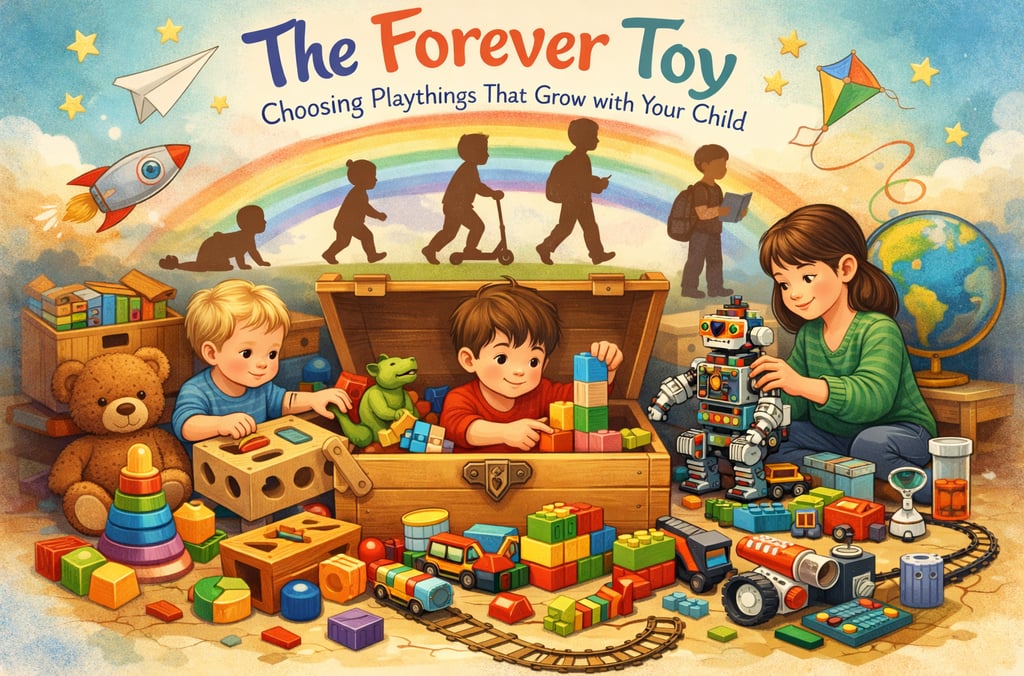
The Forever Toy: Choosing Playthings That Grow with Your Child
As parents, we have all been there. You buy a flashy, battery-operated toy that promises hours of entertainment. Your toddler plays with it for exactly three days, and then it sits in the corner, gathering dust until it’s eventually donated.
At Qluebox, we believe play shouldn't have an expiration date.
The secret to a clutter-free home and a richer learning environment isn't buying more toys; it's buying better toys. Specifically, open-ended toys. These are the magical objects that don't just entertain a child but evolve with them, offering new challenges as their minds and bodies grow.
What is Open-Ended Play?
Closed-ended toys have a single purpose (e.g., a puzzle with one solution or a robot that only dances when you press a button). Once the child masters that function, the boredom sets in.
Open-ended toys are 90% child and 10% toy. They are tools that require imagination to work. Because the child directs the play, the toy can be reinvented endlessly as the child matures.
The "2-to-5" Test: How to Spot a Toy with Longevity
When you are browsing for the next addition to your playroom, ask yourself: "Can a 2-year-old and a 5-year-old use this, but in completely different ways?"
If the answer is yes, you have found a winner. Here is what that evolution looks like in practice.
1. The Classic Wooden Blocks
This is the ultimate staple of any Montessori or play-based home.
* At Age 2 (The Physicist): The toddler is focused on gross motor skills and cause-and-effect. They are exploring gravity. The goal is simple: Stack them up, knock them down. They are learning about balance, weight, and the delightful sound of wood clattering against the floor.
* At Age 5 (The Architect): The preschooler is focused on cognitive skills and pattern recognition. Now, those same blocks are used to replicate complex patterns, build "zoos" for their animal figures, or construct bridges that must support weight. They are no longer just stacking; they are engineering.
2. The Wooden Kitchen Set
* At Age 2 (The Sorter): A toddler uses play food for vocabulary and categorization. They are learning to identify "apple" vs. "banana" and putting items into pots and taking them out again (schema play).
* At Age 5 (The storyteller): The kitchen becomes a stage for social-emotional learning. The 5-year-old is running a "restaurant." They are taking orders, negotiating who gets to be the chef, and practicing math by "charging" customers. The play has shifted from identifying objects to navigating social dynamics.
3. Nesting Bowls or Arches
* At Age 2 (The Explorer): It is a lesson in spatial awareness. Do the little pieces fit inside the big pieces? They are mastering size differentiation and hand-eye coordination.
* At Age 5 (The Designer): Those nesting pieces are turned upside down to become mountains for cars, cradles for dolls, or abstract art sculptures. The focus shifts to symbolic representation.
Why Material Matters
If a toy is going to survive the journey from toddlerhood to preschool, it needs to be durable. This is why we at Qluebox are so passionate about wood.
Plastic often cracks or loses its sheen after a year of heavy use. High-quality wooden toys are tactile, heavy, and robust. They are built to withstand the "toddler drop" phase so they can survive to see the "preschool builder" phase.
The Qluebox Philosophy
When you choose a toy that grows with your child, you are teaching them to value their possessions and to look for new possibilities in familiar places. You are slowing down the consumption cycle and speeding up their creativity.
Next time you are shopping, look for the toy that does the least—so your child can do the most.
Happy Building!
The Qluebox Team
Follow us on
Qluebox
Smart Play for Growing Minds
Contact Us
Legal
© 2025 Qluebox®. All rights reserved.
Stay Up to Date