GET ADDITIONAL 20% DISCOUNT ON FIRST PURCHASE USE CODE "FIRST20"

Let Them Smash It: Why Destruction is Just Early Physics
You spend 15 minutes carefully balancing a tower of wooden blocks. It is a masterpiece of balance and symmetry. You turn to your toddler, beaming with pride, ready to show them your creation.
And without a moment’s hesitation—WHACK.
They swipe it off the table. The blocks clatter to the floor. Your toddler erupts in giggles, and you are left wondering, "Why are they so destructive?"
Here is the Qluebox perspective: They aren't being destructive. They are conducting an experiment.
To an adult, a fallen tower is a mess. To a toddler, it is a fascinating lesson in physics. Here is why you should take a deep breath, pick up the blocks, and let them smash it again.
The Toddler as a Physicist
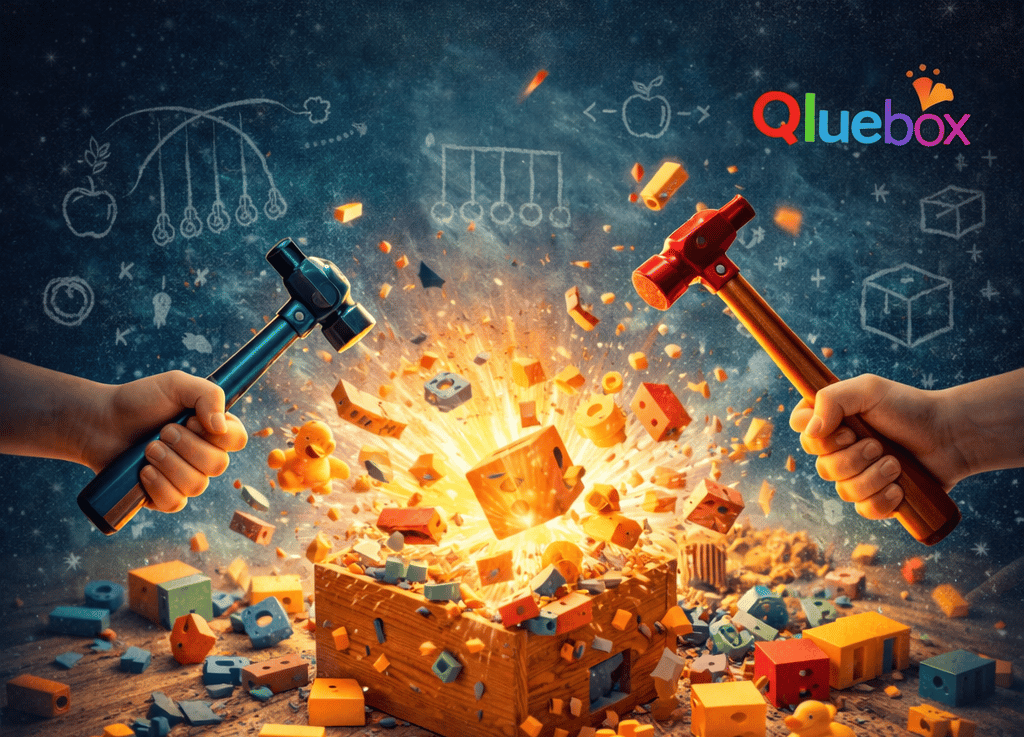
When a child knocks over a tower, they are not acting out of malice. They are testing the fundamental laws of the universe.
Think of your toddler as a scientist in a diaper. They are currently studying three major concepts:
1. Cause and Effect
This is one of the most critical cognitive leaps in early development. The child learns: "I do X, and Y happens."
Hypothesis: If I push this, it will fall.
Experiment: The push.
Result: The crash.
Verification: "Let me do it again to make sure."
If they only do it once, it might be a fluke. But if they do it ten times in a row? That is the scientific method. They are proving that their actions have power over their environment.
2. Gravity and Mass
Through "destruction," children learn that things fall down, not up. They learn that big blocks make a louder noise than small blocks (mass). They learn that a wide base is harder to knock over than a narrow one (stability). You cannot learn these concepts from an iPad app; you have to feel the weight and hear the crash.
3. Trajectory and Force
Watch closely next time. Does your child tap the tower gently, or do they haymaker it? They are testing variables.
Test A: A gentle tap makes the top block wobble.
Test B: A hard shove sends the whole thing flying.
They are learning to modulate their own strength.
Why Wood Wins the "Crash Test"
This is where the material of your toys matters immensely. If you are going to encourage "constructive destruction," you need the right tools.
The Problem with Plastic: Cheap plastic toys are often hollow and brittle. When they are smashed, they can crack, creating sharp edges. Furthermore, the sound of plastic crashing is often a harsh, clattering racket that can be overstimulating.
The Qluebox Wooden Advantage:
Durability: Qluebox toys are solid wood. They are designed to take a beating. A solid wooden block can survive thousands of "gravity experiments" without cracking.
Sensory Feedback: There is a distinct, satisfying clack when wood hits wood. It is a grounding, natural sound that provides immediate auditory feedback without the jarring noise of plastic.
Safety: Because they are solid, they don't shatter into shards. They just tumble.
How to Play "The Crash Game"
Instead of getting frustrated, lean into it. Become the lab assistant.
Build it specifically to be broken. Say to your child, "Let's build a tower really high so we can KNOCK IT DOWN!"
Narrate the physics. "Wow! You used a lot of force that time!" or "Look, the big blocks fell furthest."
Encourage rebuilding. The rule of the physics lab is: If you want to smash it, you have to help build it. This teaches patience and fine motor skills (stacking) as the "price" for the fun part (smashing).
Conclusion
So the next time your little one obliterates your hard work, don't correct them. Celebration them. They are learning that they have an impact on the world.
And luckily, with Qluebox toys, you don't have to worry about the equipment surviving the experiment.
Follow us on
Qluebox
Smart Play for Growing Minds
Contact Us
Legal
© 2025 Qluebox®. All rights reserved.
Stay Up to Date